
November 19, 2026
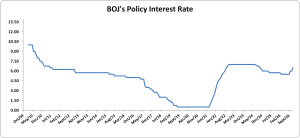
The Bank of Jamaica’s Monetary Policy Committee met on 16 and 17 November 2026 and voted unanimously to lift the policy rate by half a percentage point (50 basis points) to 6.50 per cent, with the change taking effect on 19 November 2026. In plain terms, the policy rate is what the central bank pays banks and other deposit-taking institutions on the money they keep at the BOJ. It acts as the anchor for interest rates across the economy, so when it moves up, the rates on savings, loans and short-term investments tend to follow over time.
The main reason for the increase is that inflation, the pace at which everyday prices are rising, is proving harder to bring down than expected. The Bank said there is a real risk that inflation could stay above its target range until late 2027, which would be a longer breach than it had previously signalled. Uncertainty around the outlook remains high because of the ongoing conflicts in the Middle East and between Russia and Ukraine.
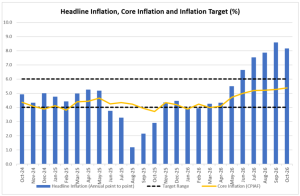
The latest numbers explain the concern. Headline inflation was 8.2 per cent in October 2026, down slightly from 8.6 per cent in September but well up from 2.9 per cent a year earlier. October was the fifth month in a row that inflation sat above the top of the Bank’s target range, driven by higher food, transport and electricity costs. For context, the BOJ’s inflation target range is 4.0 to 6.0 per cent. Just as important, core inflation, which strips out the more volatile prices of farm produce and fuel, edged up to 5.4 per cent from 5.3 per cent in September. The Bank linked this to the early knock-on effects of costlier food and fuel spreading into processed foods and some services. When price increases start to spread like this, central banks typically act to stop them becoming entrenched.
Looking ahead, the BOJ expects inflation to stay above target for most of the next four quarters, peaking in the March 2027 quarter before easing back into the range by late 2027. Investors may see a brief dip into the target range in December 2026, but the Bank stressed this is temporary and comes from comparing against the unusually high prices that followed Hurricane Melissa in December 2025. The pressures behind the outlook include higher imported prices for commodities, rising inflation expectations, government spending on reconstruction, unusual increases in local food prices tied to worsening El Niño conditions, and the spillover of commodity costs into services and processed food. Businesses now expect inflation of 8.3 per cent over the next 12 months, up from 7.3 per cent in July.
For investors worried about the Jamaican dollar, the Bank offered some reassurance. While tighter global financial conditions could threaten capital flows, the BOJ said international reserves remain healthy and provide a strong buffer, and it expects the exchange rate to remain relatively stable. It also described the banking system as sound, well capitalised and holding sufficient liquidity.
The growth picture is more modest. The economy is gradually recovering from Hurricane Melissa, but agriculture, tourism capacity and mining issues remain drags, and growth for the 2026/27 fiscal year is projected at 0.5 to 1.5 per cent. The Bank expects stronger growth in 2027/28 as reconstruction picks up, though it sees the risks leaning to the downside, particularly if tourism recovers slowly. Meanwhile, private sector lending has held steady, growing 7.0 per cent in August 2026, with loans to individuals up 8.3 per cent and loans to businesses up 5.1 per cent.
What does this mean for investors? A higher policy rate generally supports better returns on Jamaican-dollar savings, repos and short-term instruments, while making borrowing, including margin and business loans, somewhat more expensive. Higher rates can also weigh on bond prices and on companies that carry heavy debt or depend on consumer spending. Notably, though, the BOJ hinted that it may be near the end of this tightening cycle: the Committee believes the rate increases made so far should be enough to bring inflation back to target in a timely way, while staying committed to building out its tools against inflation shocks. That suggests investors should not necessarily expect a long run of further hikes, though the Bank will be watching closely. The next policy decision will be announced on 18 December 2026.
(Source : https://boj.org.jm/)
Disclaimer:
Analyst Certification – The views expressed in this research report accurately reflect the personal views of Mayberry Investments Limited Research Department about those issuer(s) or securities as at the date of this report. Each research analyst (s) also certify that no part of their compensation was, is, or will be, directly or indirectly, related to the specific recommendation(s) or view(s) expressed by that research analyst in this research report.
Company Disclosure – The information contained herein has been obtained from sources believed to be reliable, however its accuracy and completeness cannot be guaranteed. You are hereby notified that any disclosure, copying, distribution or taking any action in reliance on the contents of this information is strictly prohibited and may be unlawful. Mayberry may effect transactions or have positions in securities mentioned herein. In addition, employees of Mayberry may have positions and effect transactions in the securities mentioned herein.